Showing posts with label weather. Show all posts

Saturday, July 15, 2023

Trail of Fears

Late in the afternoon on a stormy day in April, I found myself faced with an uncommon fear of the weather. Uncommon for me, that is. Weather has always fascinated me, and rarely does it scare me. But this day was different. The day was April 27th. The weather was tornadoes. As I sped down a country road outside of Huntsville, Alabama, I was faced with both the fear of the known, and the unknown. What I knew was that a large tornado was bearing down on the town I lived in, the strength of which gave small odds for survival in a home without a basement. So I fled. What I didn't know was whether or not I was safely out of the tornado's path. With my view was blocked by rows of tall, Alabama pine trees, and a shield of very heavy rain, I was hit with this sinking feeling that only made me want to drive faster. In that moment, my mind was flooded with thoughts (Will I survive? Did I make a bad choice trying to flee? Why can't I get out of this heavy rain? If the tornado is behind me, why is debris still falling from the sky?)

Quick check. How’s everybody doing? Is your blood pumping a little? I know mine is. Fear has a way of doing that. It tends to get our blood pumping and heavily influence our decision-making. The question is, which way is it pointing? Fear isn't always a negative emotion. Sometimes it's exactly what we need to help us make a healthy decision. For many, myself included, the challenge is knowing when to follow fear, and when to disengage.

If we rewind my story from April 27th, there was a moment of decision-making where fear began to factor in more strongly. The Tornado Warning had been issued, and I was faced with a decision - do I stay or do I go? I remember looking out the window and seeing debris start to fall from the sky. In that moment, I decided to hop in my car and just go. I didn't know if our house would be hit, but knowing what I knew about the tornadoes that day, I felt it was my best choice. A healthy fear of tornadoes drove me to drive away that day. I had to push through the what-ifs and go with my gut, essentially. Now, I'm not here to argue that the choice I made was the best, but in the moment, I made the choice that I thought was the best in light of the evidence in front of me.

Staring down the "barrel of a tornado" is one thing, but what about those fears of the unknown that aren't quite as clear-cut as debris falling from ominous skies with tornado sirens blaring? What about those times you are faced with a difficult forecast, knowing you are going to have to make some tough messaging decisions that could be perceived by some as a big bust if wrong? Or what about that presentation you've got coming up that is highlighting something new, but could rub some people the wrong way? Maybe you just accepted a promotion, but are wondering if you'll be effective in the new role. This is where fear can take an unhealthy turn. 

In 2018, I was promoted to a General Meteorologist position at the NWS office in Wichita, KS. Early on in my days there, I remember being face to face with a different "barrel" - the fear of failure. Out of the blue, I started wondering if I would be able to forecast severe weather, issue good warnings, etc. Nobody is perfect, but in my 20/20 hindsight view, there was no compelling evidence from my career to that point that I would tank in the new position - no "debris falling from the sky". But in my mind, I assumed the best of the best got to work in a Plains office (regarding severe weather), and I didn't believe I was one of those. I had a real case of what many in the weather community now refer to as the "imposter syndrome". 


It was an unhealthy fear that was based in imaginative thoughts, not compelling evidence. It's one thing to see a tornado bearing down on you and then decide to drive 80 mph in the opposite direction. It's another thing to see clear, blue skies, and then decide to drive 80 mph in some direction because a tornado might form at any minute. See the difference?

But let's be honest. If you've ever faced a big fear (imminent, possible, or imagined), getting past it is much easier said than done. The imposter syndrome I faced in Wichita took me a good 2 years to get over, and to this day, it still tries to creep in once in awhile. It's a tough battle. I can't tell you how many times I wondered, while writing an AFD, briefing the next shift, or collaborating with neighbors / SPC / WPC, if what I was saying or typing was even remotely in the ballpark of being legit. In my mind, I could "hear" the gasps and laughter in people's minds as I explained my reasoning for a forecast or warning decision. I can't tell you whether people were actually gasping or laughing on the other end, but I can say that the fear of those reactions drove me to unhealthy decisions. On numerous occasions I had the right idea in mind for the evolution or magnitude of a severe weather event, but didn't say what I thought out of fear of being wrong or "laughed at". I let a might happen steer me towards a decision based in unhealthy fear. Those decisions not only hurt me, they also hurt others. Not mentioning a tornado threat to an emergency manager, even when the science says it's possible, impacts more than just me.

That's just one example from my career, but there are so many other ways we can let unhealthy fear steer our decisions. Fear of how we are perceived (our image), fear of failure, fear of being misunderstood, fear of letting down a manager or co-worker, fear of backing the GOV up and hitting another person's car, and the list goes on and on. Ok, maybe that last one is just me. The point is, whether you deal with more fear than the average person, or you just deal with the occasional fear once a year, it can be tough to work through. I certainly don't have all the answers, but I've been learning a lot about fear management over the years, and would love to share some ideas that might help you along in your journey. Below are some Key Takeaways from what I've learned so far...

YOU’RE NOT ALONE. If you don’t get anything out of this post, I hope that you at least hear that you are not alone. I intentionally shared some of my fears for this reason alone. I can’t tell you how encouraging it is when I hear someone else share about a fear I also deal with. You’d probably be surprised how many different fears even your most respected friends, colleagues, or mentors deal with. On a side note, as you feel comfortable, sharing a fear with someone else could be just as helpful for them as it is for you. Fears aren’t fun to share, I get it, but just a thought. This could be especially helpful for mentors. I believe the best mentors are the ones who are the most real.


WORKING THROUGH FEARS IS A PROCESS. This is a reality I’ve had to come to terms with. Working through fears usually takes time and practice. One of the worst things you can do is beat yourself up every time you let an unhealthy fear impact a decision. I get so annoyed with myself when I don’t do what I know I should do, and vice-versa. If this is you, give yourself some grace. Working through fears is like riding a bike. You just can’t hop on and expect to be zooming down the street from day 1. Make sure you are giving yourself room to grow. One thing I’ve found to be helpful is journaling. Sometimes I’ll take time to go back and read an entry from the past and see how I’ve progressed over time with a particular fear. I've also found it helpful to talk with a trusted friend, family member, or co-worker. The HOW will vary from person to person, but what’s important is progress. Instead of focusing on never worrying about issuing warnings, for example, look and see if you are worrying less and less about warning decisions.


DON’T ENGAGE. One of the things a good friend of mine challenged me on recently is to not engage in fearful thoughts when they pop in my head. I know…WAY EASIER said than done. But, remember, it’s a process that takes time. I’ve had so many moments where I thought, “don’t engage, don’t engage” …only to then engage the fearful thought. It’s like trying not to comment on a politically charged post on social media. But, the more and more I’ve practiced not engaging in a fearful thought, the better I’ve become. I love the analogy Craig Groeschel gives. He compares fearful thoughts to a trail in the woods. The more a trail is walked on, the easier the path becomes for future hikers. Similarly, he argues, the more we engage in a fearful thought, the more established a “thought trail” will become in our mind, making it easier for the fear to resurface again. As much as possible, the less we can engage in those thoughts, the harder it is for them to resurface in the future. 

Similarly, in Disney’s “Luca”, one of the characters tells another to say “Silenzio Bruno!” to those fearful thoughts. The caveat here is that this isn't for everyone. As Ian Cron and Suzanne Stabile point out in "The Road Back to You", some personality types actually do better when they engage in a fearful thought and talk their way through it. 

BE INTENTIONAL. This one can be challenging, but sometimes I will intentionally put myself in a situation where I typically struggle with a particular fear. For years, public speaking made me super nervous. So how did I work through that fear? I intentionally put myself in situations where I would be required to speak in public. Many times I stuttered, or spoke too softly, or messed up an important point, but over time, it became less and less scary. I still get nervous before speaking in front of people, and that may never go away, but the fear of public speaking doesn't have the hold on me that it used to. Maybe for you it's the fear of forecasting, issuing warnings, or coming up with the code for a new GUI. Choose the intentional moments wisely, but sometimes the best way to break the fear of falling off a bike is to just get on.


Bottom line (not up front), fears are painful, annoying, and mentally exhausting. But, you are not alone, and I believe they are manageable. Understand the reality that you may not completely get over a fear, but also know that fears don't have to be the primary driving factor in decisions. Be patient with yourself, talk them out with others, and develop good thought habits. 

I'll leave you with this. Michel de Montaigne said, "He who fears he shall suffer already suffers what he fears.". It takes a few times through to grasp what he is saying, but the gist of what I believe he is saying is that unhealthy fear drives us to make unhealthy decisions, which in essence causes unnecessary impacts for both us and those around us.

Thanks for reading this far. Reading through a post about fear can be challenging enough, and I know for some it may bring up painful reminders. Heck, just typing it out has brought up some fears. I’m not here to tell you that a 4-step process is all you need for removal of all fears. Some fears go away, other stick around. Whether you are conquering fears or managing them, my hope is that this post will help you move towards a place that's driven less and less by unhealthy fears.

If you have found some helpful ways to manage fears, please share away! We can learn together.

Friday, December 17, 2021

The Making of a Historic Wind and Fire Event

The recent historic wind and fire event that literally blew through the Great Plains was anomalous in every sense of the word. But, not all anomalies are created equal. We see high-impact events all the time, but not all fall into the historic category. With today’s post I wanted to dig into some of the science behind this event and what set it apart from other high-end events.

Let’s first set the stage. A potent shortwave ejected out of the Central Rockies Wednesday morning, December 15, 2021, and very rapidly lifted northeast from the Central Plains into the Upper Midwest/Great Lakes by Wednesday night. Negatively-tilted shortwaves often mean business, and this one was no different.

What set this system apart from similarly-tilted shortwaves was the very strong mid-level jet that accompanied it. The observed 12z sounding at ABQ showed a 500mb wind speed of 100kt, while the observed 12z DDC sounding measured a 700mb wind of 65 kt. 


The 21z RAP 500mb analysis (shown earlier) suggested a peak mid-level wind speed of around 120 kt at 500mb as it moved out over Kansas. A mid-level jet that strong this time of year is more unusual.

Let me pause here a minute. Take a close look at that DDC sounding again. 


 On a day like this, with deep mixing expected, you can sometimes use an observed morning sounding to get a rough idea of how strong the winds might be in that area later in the day. In this case, the morning started with a fairly stout inversion across western and central Kansas, but the forecasted combination of daytime heating with cooling aloft (beneath the shortwave) suggested the potential to mix deeply, with the sounding revealing how strong the winds may be within that mixed layer. The DDC sounding, for example, showed 60-80kt in the potential mixed layer, suggesting peak wind potential of 80-90 mph for any area that could mix deep enough. The 21z RAP analysis reveals the areas from western to central Kansas where some of the deepest mixing occurred (shown by the steepest low-level lapse rates).

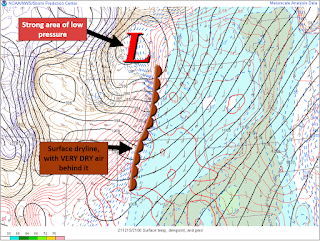
At the surface, an unusually deep surface low developed, adding a strong pressure gradient component to the wind potential. In Minnesota, the low pressure set arecord. The strong downslope drying east of the Rockies also helped setup a sharp dryline across Nebraska and Kansas.


The ECMWF’s Extreme Forecast Index (EFI) really helps put it all together. The EFI is a great forecasting tool to help determine which events may be anomalous. It can also reveal the anomalous events that are not like the others. 

On the map above, you’ll notice the EFI is maxed out (pink shading) over a large area of the Plains. Looking closer, though, you’ll notice a Shift of Tails (SoT) of 2. In my experience, that’s a separating marker between events. For wind, the combination of a high EFI value AND a SoT of 2 puts an area in a higher-end, potentially record-breaking, setup. The end result? A widespread area of verystrong, damaging winds. The wind, alone, was anomalous, but this event didn’t stop there.

When you overlap strong winds with a warm and very dry airmass, bad things tend to happen. This event appeared to be a classic fire outbreak setup, as researched and shown by Lindley,et al.


Adding fuel to the fire, literally, was very dry antecedent conditions. From an anomaly standpoint, there was a very large footprint of dry conditions across Kansas, with much of the state running 10-25%, or less, of normal for rainfall (since November 1, 2021). Fire weather aside, this also added to the risk of blowing dust.


Higher end fire weather days do occur on the Plains, but another aspect of this event that sets it apart is that it came in December. This December has been an active one for fire weather in Kansas. In fact, since 2006, only one other December was more active (2017). Outside of 2017, no other December in that time period even comes close.


Lastly, I want to highlight the anomalous combination of shear and instability, by December’s standards. The focus for severe weather was over the Upper Midwest, but it all started in the Central Plains. A plume of high PWats surged north through the Central Plains, ahead of the ejecting shortwave, and went well north all the way into, and through, the Great Lakes region. Getting that amount of moisture return that far north in December is a low frequency occurrence, and more unusual in December.


A moistening airmass beneath steep lapse rates and cooling temps aloft supported modest destabilization, and a weakening cap, ahead of the advancing dryline/Pacific cold front. This was accompanied by more than adequate shear for organized severe convection.


The shear/instability combo isn’t unusual for this part of the U.S., in general. In December, though? Not so much. An anomalous combination of shear and instability stretched from Kansas to Michigan, setting the stage for a remarkable swath of severe weather, including several tornadoes. And notice, once again, a Shift of Tails of 2 on the EFI plots below.

For perspective, Kansas, Nebraska, Iowa, and Minnesota have had more Severe Thunderstorm Warnings issued this December than any other December on record (dating back to at least 1986, based on IEM data). Since this post was focused on the science and anomalies of the event, though, I’ll leave the product climatology for another day. 

In summary, a truly historic, mid-latitude storm system had a “perfect storm” combination of high-end anomalies from top to bottom, and everywhere in between. Anomalous features regularly come around, but not all at the same time. Every now and then, though, they line up in perfect sync, often with devastating impacts. This post only touches the surface of the science involved in this event, but I hope it provided a little context to just how anomalous and unusual this event was over a huge footprint of the U.S., while also serving as a mini training moment for what to look out for in future higher-end wind and fire events. 

NOTE: Some of the mesoanalysis images shown above were from the NWS Wichita’s event summary. I helped make that summary, and the images I used in this blog are ones I made. I just wanted to clarify that in full disclosure to make sure it is understood that those images were not improperly taken from someone else's work.

Thursday, April 26, 2018

Probabilistic vs Deterministic Messaging

This past Winter, our office (TFX) participated in the NWS' prob snow experiment. For those who might not be familiar with what that is or what it involved, it was a way to experiment with utilizing snowfall probability information within operations and decision-support activities. Perhaps in another post I'll ponder the good and the bad about the experiment, itself. But, for now, I wanted to take it a different direction.

Related to that experiment, a question was posed...is probabilistic or deterministic information better when it comes to messaging? At its core, this question is part of a larger and ongoing debate related to the effective communication of weather hazards. That debate is a fascinating and challenging one, but is probably too long for one post. For now, I'll just address the one piece of the puzzle that focuses on probabilistic vs deterministic messaging.

When it comes to snowfall amounts, what do we often see? Ranges. And, we seem to gravitate toward certain ranges at that. 1-3", 3-6", 6-12". If you are one of those rebel types, you might even use 2-5" or 3-7". Oh the humanity...

The interesting (note I said interesting and not necessarily bad) part about the end-user's use of ranges is the seemingly automatic focus on the high number. Knowing the worst-case scenario isn't a bad thing in of itself, but how it's used can be. Just before a winter storm a couple months ago, a friend of mine texted me and said, 'Hey! I heard we are supposed to get 7" of snow'. The winter product from our office said something to the effect of 2-4" with isolated amounts up to 7", if I remember correctly. My friend read that as we are getting 7" of snow. I doubt he was alone in that assessment.

I often give ranges when messaging upcoming snowfall events and I am not here to argue against that. My end-game is to think through the different possibilities. Recently, I decided to give the ole probability method a try. Prior to a winter event, a caller asked how much snow we expected for her area. With experimentation on the brain, I boldly informed her that there was an 80% chance of exceeding 4" at her house. To which she replied, 'So, do you think we might get a foot?'.

The sample size on my little experiment is incredibly small. But, how much would you be willing to wager against her response representing a large part of the population? One thing that stuck out to me in her response was the 12" amount. After talking with her more, I got the sense that 12" is when she starts having problems in her world. It's the point when her daily plans change. I believe that is why her mind immediately jumped to a foot. For her, my arbitrary percentage-greater-than-x-amount didn't help. Now, had I given her the probability of exceeding 12", well that could have been a different story. Would she have been able to interpret it effectively? I don't know.

When it comes to the general public, the thresholds for when action is taken is all over the place. That lady's threshold was 12". A recent transplant from the South would probably have a different response. So where does that leave us as Meteorologists? In a very challenging position. We have a responsibility to message hazardous weather, but to a group of people who don't even share a common breaking point.

On the flip side, we have individuals or groups (DOT, emergency managers, etc) that often DO have specific thresholds that we can know. I watched an enlightening presentation recently that looked at the potential effectiveness of probability information for decision-makers like the DOT. I get the sense that probability messaging works great for them. Honestly, I believe it could work great for the general public as well. The challenge is our inability to know each and every person's breaking point.

One part of the prob snow experiment that I really liked was that it gave probability information for several breaking points (2", 4", 6", 8", 12", 16"). We may not be able to know all thresholds, but we can certainly try to cover as many as possible in our messaging, within reason. But, that's just snow. What about rain, hail size, tornadoes, tornado strength, etc? Do we say "this storm will produce up to golf ball size hail" or "there is an 80% chance of exceeding quarter size hail?". I'm not sure a warning product is the place to put a lot of probability wording, if nothing else but for the sake of time/understanding. Imagine The Weather Channel scrolling the probability of multiple thresholds, or hearing those probabilities being read over Weather Radio broadcasts/statements?

My answer to the question of probabilistic or deterministic? The verdict is still out, but I imagine it involves some sort of a mix that relates to the known users, the product, and the event. I don't know if there will come a time when all of our messages are completely understood, used correctly, and heeded, but working through and experimenting with this piece of the puzzle is beneficial to the larger discussion regarding effective communication. In the spirit of probabilistic messaging, I will inform you that there is a 100% chance that I will blog more about effective communication down the road...

Monday, April 16, 2018

My VTEC Coding is Changing

Warming temperatures following an active and very snowy winter = flooding. I've put out more Flood Warnings in the past 3 days than I have the past 3 years. RiverPro isn't the most user-friendly product generator, which means a lot of extra QC of the VTEC coding. That got me thinking about the "VTEC coding" of my life and how it is about to be changed.

I recently accepted a position with the NWS office in Wichita, KS, so perhaps this would fall under the continuation (CON) category? It is quite the exciting change for my family and I. Career-wise, my focus in research, projects, etc has often revolved around convection, and what a great opportunity and location for continuing that! But, as exciting as this "CON" is, I would be remiss to not look back at the past 3 years. Just like when continuing a warning...you would be remiss to not look back at what the storm has been doing up to this point.

When I came to Great Falls, I could not believe how fortunate I was to get the opportunity to work for the NWS. I still look back on that time and am so grateful. When I walked through the doors of TFX 3 years ago, I had no idea what was ahead. In a few weeks, I will walk out the doors of Great Falls a changed man.

I know, I know, that sounds so cliche...and I am not a big fan of phrases like that. However, this one could not be more true. See, I came to Great Falls being very particular about many things, both in the field of Meteorology and in my personal life. Wow did I ever get punched in the face in that area! Some things are worth being more picky about, but it's just not healthy to pick every battle. I picked a lot of battles in the beginning and I regret that. But, through some coaching and tough experiences, I came to realize just how picky I was. It blew my mind. I never fully realized I was that way. So much so, I ended up apologizing to my family and close friends, many years after the fact, for how picky I had been. Have I perfected the issue? Nope. But, I am much more aware of it which has helped me to be more intentional about being careful to let some things go. Life is just so much less stressful when you can learn to let certain things go. It's worth the try...

Also, it turns out, I have struggled with communication, fear, and self-confidence issues. Some of those struggles I was more aware of, but didn't necessarily know the best way to address them. Let's just say the past 3 years have been like going back to college. Only this time my major was "Becoming a Better Man, Husband, Dad, and Co-Worker". Some of the courses were pretty intense, but SOOOO worth it. To...um...use another cliche phrase, my life will never be the same after my time here in Great Falls.

Being able to serve people through working with the NWS is a dream come true. Little did I know just how important this dream would be in my life. It has given me the opportunity to read more, to spend more time with my family, to be challenged and to grow as a Meteorologist, to be challenged and grow as a husband/Dad/co-worker, and also to cross paths with people who have had a profound impact on me.

As my family and I head to Kansas, I go there not as a perfected man. Rather, I go there with an improved understanding of my strengths and weaknesses and how to better address the areas where I fall short, while being humbly confident in the areas where I excel. Perhaps there were many different paths to ICT, and hindsight is 20/20, but I wouldn't have had it any other way.

Friday, February 16, 2018

The Impact of an Active Pattern

WPC recently tweeted about one way to view the severity of a winter season. Notice on the map the "Severe" and "Extreme" categories showing up over Montana. The pattern we have been in lately and, seemingly, much of the winter has been very active across the state, including much of our CWA. I very much enjoy active weather patterns and I will venture to say that many others in this field do as well. But, extended periods of active weather can take its toll.

Our ongoing stretch of active weather more or less started back in early October when our northern counties were dumped on by a heavy, wet, and damaging snowstorm. We've had breaks, some longer than others, but then we'll get a barrage of shortwaves. The problem is that they haven't always come neatly spaced. In some cases, the lull from one round of precip to the next has only been 6-18 hours. Some have all snow, others mixed precip or even just plain rain. From a forecasting standpoint, alone, it has been very tricky at times, especially considering that from north to south, our CWA is about 2/3 that of the state of Alabama. That's a lot of ground to cover. Oh, and don't forget to add complex terrain to the mix.

But, it's Montana. It's winter. Winter = snow in Montana, so nothing new. Snow is as common here as severe weather is in Oklahoma. Common or not, if it all comes in waves very close to each other with little breathing room, it can become an impact for forecasters. As I mentioned earlier, I love active patterns, especially when convection is involved. Even active winter weather can be exciting. But, even your favorite weather patterns can be draining. At this past year's SECAPS conference in Mobile, Joey Picca (SPC) made a great point. He said, "We all get tired and need breaks, even from topics we love the most..."

Active weather can complicate messaging and open the door to more confusion than already exists. It can cause red and green pixels to start blending together after 12 straight hours on radar. It may be a struggle to issue YET ANOTHER Winter Weather Advisory, when it feels like you've already issued 5,000. Breaks are good. And when they don't happen, moral can get a bit sporty.


And, it's not just us. What about the snowplow drivers working countless nights or the emergency manager who can't remember when the last time he went a week without hearing a tornado siren going off? Locally, conversations within our office, with local partners, and with the public suggest that fatigue factor is kicking in some. Mike Rawlins (a local TV Met) said, "The hits just keep coming". People are beginning to ask if spring will EVER come.

I suppose in thinking through the impacts of extended periods of active weather, I'm not so much here to make some amazing point or observation. But, I feel that it is important to consider these factors when thinking about messaging, staffing, or purely from an empathy standpoint when a local partner asks when the pattern will break. Active weather causes a variety of impacts and they aren't just travel-related. This is something that has struck me more recently and is something that I believe is good for all of us to keep in mind for ourselves, those we work with, and those we serve.

Thursday, May 25, 2017

What Small Town USA Can Teach Us

Last week I did a spotter talk up in the far NE corner of our CWA...a rural town of just over 1200 people and located just south of the US/Canadian border (Chinook, MT). 1% of the population showed up. I would say most of our CWA is rural, with a handful of urban areas mixed in. Leaving that meeting, I started thinking about the needs of small town USA and, of all the things we do in the NWS, what is the most helpful for them.

A couple months ago, I wrote a post about picking your battles. Talking to the people in Chinook, I began to realize that I may be missing the point, or not focusing on the right things, with some of the battles I've picked. When you work in an office that is in a more urban setting, it can be easy to focus on the needs of the urban areas and forget the "little guys". I realize we can't hit every single need of every single person we serve. But, going out on outreach trips can sure be eye-opening.

For me, it was eye-opening in several respects. First off, small town USA doesn't necessarily mean the land of no cell phone signal and no WI-FI anymore. The sheriff had a fancy smartphone AND a cool-colored cover. The nearby fire chief also had a smartphone AND uses the mobile version of NWS' EDD. I gotta be honest, I didn't even know we had a mobile version of that site.

Then there's our products/services. The nearby airport manager said our DSS/partner emails we send out are the most helpful thing to him, not the TAFs. I thought it was cool that this small town airport even reads those emails. I mentioned to the sheriff that he could call us anytime for any weather-related help. He replied that after my spotter talk, he may have enough education to not have to call when the next storm approaches the town's summer fair. Does this represent all small towns? Probably not, but I'll bet it's repeated many times over. And, by the way, this is not meant to be seen as negatives about smaller towns, but as the reality of what's actually going on and what is used in smaller towns.

I guess the point is, we can fight all we want for what we THINK small-town USA needs, but after getting out and talking to the people, we may find we are fighting for the wrong things, at least as far as they are concerned. That's not to say that fighting for the needs of big city USA is wrong if it doesn't mesh with small-town USA. For me, small-town USA has simply helped keep things in perspective.

At the same time, this trip also helped me to see that there are things we fight for that I have always assumed were more helpful for larger cities (like the mobile EDD site). Who knew that working on that site, or something similar, may actually help big and small towns. And, while being available to provide support over the phone is great, maybe it's just not for some small towns. I believe our forecasts, warnings, DSS, etc is incredibly important to the mission of the NWS. But, what struck me that day is that all of that MAY not be what is most helpful for some small towns. Maybe outreach and education is our best service to them. Teaching the sheriff how to spot signs of rotation with an incoming storm might just be what helps him best serve his people even more than an email or phone call. When the sheriff said to me that he may not need to call us, it made me think of my kids. One day they will go to college and not have Mom or Dad right there next to them to help make a decision. That's when common sense and parental education comes in. Hopefully we will have taught them enough to make an informed decision. I hope my talk provided the sheriff enough info to make an informed decision whether he is able to reach out to our office or not.

Going forward, it will likely still be tricky trying to decide which battles to pick and which ones to let go of, but this recent interaction with the people we serve really gave me something to chew on. All of these ideas I've held dear may need a dose of ruralness (yes, I think I made up a word) to keep me in check!

Wednesday, March 22, 2017

Picking Your Battles


Being a husband, a father, and someone who does shift work, I tend to do most of my writing/thinking at night. Perhaps I should change the name of my blog to Roger’s midnight ramblings. Of course, many of the people who probably read this blog (after publishing their grids, of course!) also do shift work. Tonight’s ramblings revolve around navigating through the various passions in our field.

Being passionate is great and, in my opinion, an integral part of what we do. While we probably all share some common passions, there is also diversity in what drives us and that is ok. If everyone in an office/company/TV station is passionate about severe weather, what happens when the next snowstorm comes around? If everyone in research only cared about winter weather, what good is that for severe weather? Diversity in passions is healthy.

Lately, though, I’ve come to see that, if unchecked, passions can be unhealthy at times. See, out of our passions come strong opinions/beliefs. Diversity in passions is a beautiful thing, but it means we don’t all agree on everything. Someone who isn’t as passionate about severe weather may not feel as strongly about certain severe weather-related things as someone who is passionate in that area. Or, maybe you have a case of two people who are passionate about severe weather, but hold very strong and opposing opinions within that passion. It’s these opposing, strong viewpoints that I’ve wrestled with more recently.

I don’t know if this is a part of my personality or not, but I have always struggled with seeing the good in any opposing viewpoint. Not a good place to be! The last two years in the NWS have taught me, more than any other time in my life, that I simply cannot live this way. Realizing this has been an important step for me personally, but putting it into action? Now that’s a whole other ballgame. Keeping an open mind is tough and requires some painstaking effort at times (or, at least, it does for me anyway). Even with this new mindset, there are still certain things that for the life of me I cannot understand how someone could see it differently. In a church, a pastor might ask for an “amen” here, but since this is a blog, can I get a “write on!”?

But here’s the thing. In my experience, some of the things I have felt very strongly about turned out not to be as big of a deal as I made them out to be, or simply misplaced, after actually listening to the opposing side. Man, some of those times I really didn’t want to change my mind. Now, before people start questioning every opinion they hold dear, let me be clear. I do think there are things worth fighting for. Countless people throughout history stood up for what they believed in and positive change came about from it. What the past two years have taught me, though, is that I have to pick my battles.

I’m not saying we need to put all of our opinions under a microscope, but I do think it is worth taking some time to think through those strongly-held opinions to see what our motives might be, what facts support (or disprove) our beliefs, etc. This is a big reason why I blog. Even if no one else reads these, writing helps me to think through issues. Maybe that works for you, maybe it doesn’t. Perhaps sharing things with co-workers or posting your opinion in 160 characters or less works. Maybe it’s thinking on the car ride home. It won’t always be easy, but in my experience it has helped me to figure out which battles are worth fighting and which aren’t. It has also helped me to figure out what things I am probably way off on and which things I might be on to something.

You can probably all think of that person who seems to always pick every…single…little…battle. Perhaps you have been that person. I know I have before! Looking back, I don’t know what I was thinking. When we pick every battle, we run the risk of becoming white noise…a clanging cymbal that people don’t want to hear or don’t take a seriously. In our field, there are a lot of things worth fighting for in my opinion. But, there is a time and place for everything and, in some cases, it just might be that a battle simply isn’t worth fighting at all. I struggle with the idea of letting go of some battles. And, gosh, where do you even start on deciding which to let go of? Perhaps letting go of one or two here and there will help bring about change in those things that are even more important. I can’t tell you what battles you should fight and which you shouldn’t. That is just a part of the sportiness of this whole process. Heck, some things worth fighting for in one company or office may not be worth it in another.

On a quick side not here, in this whole process of picking my battles, I’ve been reminded to show a little grace when others pick every battle. I’ve done it before and maybe many of you have as well. Perhaps you’ve got the picking your battles thing all figured out, but that’s not the case for all of us. It may be annoying when others do this, but try to cut them some slack. You might even be able to help them work through what is important and what isn’t. Several in my office have helped me work through some battles and I am better for it. Whatever you do or wherever you work, there’s a good chance you are part of a team. If we work together through our weaknesses and show a little grace, we are probably all better off for it.

In this struggle of picking our battles, it may be easy to lose a little passion in the process. Don’t let that happen! About 6 months into my career with the NWS, I let this happen and, boy, do I regret it. Just because you may have to back off on some things, doesn’t mean the passion for the job should as well. I think the key is to find that balance of when to stand up and when to back off a bit. Plus, think of it this way. If on the flipside you do pick every battle, you’re probably going to get burnt out. What good does that do you or anyone else? I love seeing people find their niche/their passion. I equally hate seeing people lose their passion. If I can stress anything, please don’t lose that passion! Keep it in check and healthy, but don’t lose it. In the words of Leslie Nielsen, “We’re all counting on you”.