Sunday, February 20, 2022

ICT Reflections

As my time comes to a close here at NWS Wichita (ICT), I wanted to take a few moments to reflect back on the past several years. Maya Angelou said “I have great respect for the past. If you don't know where you've come from, you don't know where you're going.” I couldn’t agree more. In the craziness and excitement that comes with moving, there’s something about taking the time to stop and think about what has happened, where you’ve improved, what still needs work, and how all of that may factor into your future. 

When I heard that I was going to get an opportunity to work at a Plains office, I was amazed. I’ve always seen the Plains as a place where the best of the best work, and I didn’t see myself as being that caliber of a Meteorologist, especially with severe weather. Don’t get me wrong, severe weather is a passion of mine. I just didn’t feel like I had the right skill set yet for Plains’ convection. But, an MIC took a chance on me, and invited me into the wild weather that is the Plains.

As if on cue, I got a welcome to the Plains moment almost immediately. A week after I arrived, Eureka happened. It was one of my first forecast shifts here at ICT and I’m not even sure I had tornado anywhere in my AFD. In the office that day, we went from “Hey, is that a developing cumulus cloud?” to “How fast can we get more people into the office?!?!”. 

12 hours later, on my way home, I seem to recall thinking, ‘what did I get myself into?’. I’m sure each area of the country has a particularly humbling weather phenomenon, or two. On the Plains it’s convection. 

A couple of things the past three years has taught me is to 1) not worry what people think and 2) to be ok with misses and mistakes. Ok in the since that, trying your best and still coming up short doesn’t make you a bad forecaster. It might reveal a weakness or a need for additional training, but it doesn’t equal bad. One of the best things my MIC here told me is that all new positions have a growing in period. Hearing him say that was such a relief! Mistakes are a normal, and healthy, part of growing. What’s great is that growth leads to improvement. I’ve learned that I must be ok with mistakes, that I have to be humble enough to admit them and look for ways to improve, and to be intentional to fight against the fear of failure and what people may think about me when I fail. It basically took my entire time here at ICT to be comfortable with all of that, but I can’t tell you how freeing it is as I look ahead to whatever new, and humbling, challenges await.

Speaking of Plains weather, my goodness how fast things can change, both in the short-term and in the long-term. Eureka was a short-term example. With Plains events like that, you can literally go from 0 to 60 (cumulus cloud to tornado in about 60 minutes). The thing is, if you’re not prepared, operations can go sideways in a hurry. By nature, I’m a perfectionist. Those types of events have helped me to learn how to better prioritize duties (not everything can be given a #1 priority), and to be ok with some things, like the RWS, not getting as much attention. Oh, and it’s taught me to ASK FOR HELP! Man, sometimes in my struggle with perfectionism I have held onto a duty, or duties, too long without asking for help. When things are literally blowing up in the short-term, I’ve got to be ok with asking for help. It has also helped me to work on not letting the fear of what others think factor into decisions. When things are going sideways, you just can't waste time on unhealthy worries. Easier said than done, and I'm still working on that one...

In a longer-term example, it’s amazing to me how fast you can flip between flood and drought on the Plains. 


2019 saw a Kansas state record for annual rainfall. We couldn’t shut off the waterworks that year. At one point during the convective season, every single river forecast point in our CWA was in flood. We were staffing nearly round-the-clock coverage for rivers, alone. 2020 and 2021? Every time we tried to turn on the faucet, it broke. I have never gone that long without seeing measurable rain in my life. You almost stop forecasting rain even when model guidance gives you a 99% PoP. It became the ‘ole, I’ll believe it when I see it routine. The problem on the Plains is, drought or not, the wind never shuts off. Wind + dry = fire. I worked fire weather all the time in Montana, but it’s a different ballgame here. We don’t have huge forests full of timber that climb tall slopes. We just have fires that move horizontally fueled by 50-70 mph winds, making fire weather days feel more like severe weather days. And sometimes, we actually have fire weather and severe weather on the same day.

Oh, and the convection here. The summer is so funny because you wouldn’t believe how many days you come into work with 5000 CAPE, and you wouldn’t believe how low the percentage of those days actually see storms. I mean, how do you look at that much CAPE and not start “seeing” TCU develop on satellite. It’s like looking down a hot road thinking you’re seeing water when, in reality, it’s just a mirage. You know you’re a seasoned forecaster on the Plains when you don’t bat an eye at 5 grand of CAPE. But here’s the thing, every now and then, convection manages to develop in that kind of environment. You will never see an updraft go severe so quick. Those are the days you issue a SVR before rain even hits the ground. The 5000 CAPE days, and convection in general here, have taught me to be ok not knowing, with certainty, the answer to the question, "Will convection form or not?". It’s also taught me the value of telling people what you know when you know it. When I started here at ICT, I tended to lean away from telling people there may be tornadoes, for example, unless I had moderate to high confidence in them occurring. Since then, and with the help of the Watch-Warning Gap Testbed, I’ve learned to be ok not having all the answers, but still being able to give the public and our partners valuable information, even when confidence is low. For me, it’s also been an additional exercise in leaning away from perfectionism in this job.

I have been so fortunate to work with such a solid group of Meteorologists, not just at ICT, but all around this area. I have always been passionate about the science, but I didn’t know what I didn’t know until I came here. I have learned SO MUCH on the science side, and it has made my passion for the science all the more important to me. I have watched how the solid science foundation of our office has served our partners well, and it has been so encouraging.

At the same time, my time here has taught me to better balance people and passions. It’s great to be passionate about things like science and operations, but unregulated passion can be a problem. Albert Einstein once said, “Concern for man…must always form the chief interest of all technical endeavors. Never forget this in the midst of your diagrams and equations.” 

I’ve come to see that improvement as a Meteorologist isn’t independent from improvement as a person. One of the biggest regrets from my time at my first office (TFX), was too many times putting passion before people. It made me overly critical, grumpy, and not the best co-worker. I know I can’t camp in disappointment about past mistakes, but my hope is to let it be a reminder of what not to do. ICT gave me my first opportunity to really work on better balancing the things I am passionate about and concern for others. It’s had a huge impact on how I act as a co-worker. I don’t run around trying to diminish my passion, but I've been learning how to tone it down in certain circumstances so that I don’t unhealthily burn bridges or hurt working relationships.

Remember the 2004 Red Sox? I believe part of the reason they won the World Series is because the team made the game fun. They had fun and they worked well together and they won. Just a bunch of friends playing backyard baseball. That's the culture I've been fortunate to be a part of here. ICT has helped me to love Meteorology again, and to have fun serving.

My time at ICT has also taught me that putting people first sometimes means choosing a hill to die on. A friend of mine challenged me recently to choose those hills wisely, while acknowledging that there are hills worth climbing. The key is knowing which ones. One of the most important things in my career that I’ve learned here is to be courageous to climb a hill or two when necessary, and be intentional about improving in the area of conflict resolution. Choosing not to die on any hill is just as bad as choosing to die on every hill. This is a tough one, and I think there will always be room for improvement, but I’m glad I was challenged in this here.

I am SO THANKFUL that my career brought me through ICT and the Plains. I wouldn’t have it any other way. I am a better husband, friend, co-worker, and Meteorologist because of it. I’ve had the opportunity to work some remarkable and memorable weather events, some of which I may never experience again. I don’t fear Plains convection anymore. In fact, I will miss it. 

I will also miss the people I’ve had the opportunity to work with here. I've moved a lot over the years, but this will definitely be one of the tougher ones. As tough as it is to leave them behind, I can rest knowing the weather community is pretty “small”, and I know it won’t be the last time we get to interact with one another. Looking ahead, it will be neat to get to know another sector of the weather community that I haven’t yet interacted with as much. There will also be humbling challenges and new memories, hills to die on and hills to pass by. In the good days and the sideways days, I feel better prepared for this new season thanks to my coming-to-a-close season here at ICT. 

Friday, December 17, 2021

The Making of a Historic Wind and Fire Event

The recent historic wind and fire event that literally blew through the Great Plains was anomalous in every sense of the word. But, not all anomalies are created equal. We see high-impact events all the time, but not all fall into the historic category. With today’s post I wanted to dig into some of the science behind this event and what set it apart from other high-end events.

Let’s first set the stage. A potent shortwave ejected out of the Central Rockies Wednesday morning, December 15, 2021, and very rapidly lifted northeast from the Central Plains into the Upper Midwest/Great Lakes by Wednesday night. Negatively-tilted shortwaves often mean business, and this one was no different.

What set this system apart from similarly-tilted shortwaves was the very strong mid-level jet that accompanied it. The observed 12z sounding at ABQ showed a 500mb wind speed of 100kt, while the observed 12z DDC sounding measured a 700mb wind of 65 kt. 


The 21z RAP 500mb analysis (shown earlier) suggested a peak mid-level wind speed of around 120 kt at 500mb as it moved out over Kansas. A mid-level jet that strong this time of year is more unusual.

Let me pause here a minute. Take a close look at that DDC sounding again. 


 On a day like this, with deep mixing expected, you can sometimes use an observed morning sounding to get a rough idea of how strong the winds might be in that area later in the day. In this case, the morning started with a fairly stout inversion across western and central Kansas, but the forecasted combination of daytime heating with cooling aloft (beneath the shortwave) suggested the potential to mix deeply, with the sounding revealing how strong the winds may be within that mixed layer. The DDC sounding, for example, showed 60-80kt in the potential mixed layer, suggesting peak wind potential of 80-90 mph for any area that could mix deep enough. The 21z RAP analysis reveals the areas from western to central Kansas where some of the deepest mixing occurred (shown by the steepest low-level lapse rates).

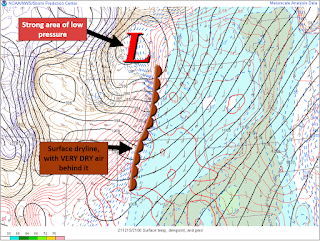
At the surface, an unusually deep surface low developed, adding a strong pressure gradient component to the wind potential. In Minnesota, the low pressure set arecord. The strong downslope drying east of the Rockies also helped setup a sharp dryline across Nebraska and Kansas.


The ECMWF’s Extreme Forecast Index (EFI) really helps put it all together. The EFI is a great forecasting tool to help determine which events may be anomalous. It can also reveal the anomalous events that are not like the others. 

On the map above, you’ll notice the EFI is maxed out (pink shading) over a large area of the Plains. Looking closer, though, you’ll notice a Shift of Tails (SoT) of 2. In my experience, that’s a separating marker between events. For wind, the combination of a high EFI value AND a SoT of 2 puts an area in a higher-end, potentially record-breaking, setup. The end result? A widespread area of verystrong, damaging winds. The wind, alone, was anomalous, but this event didn’t stop there.

When you overlap strong winds with a warm and very dry airmass, bad things tend to happen. This event appeared to be a classic fire outbreak setup, as researched and shown by Lindley,et al.


Adding fuel to the fire, literally, was very dry antecedent conditions. From an anomaly standpoint, there was a very large footprint of dry conditions across Kansas, with much of the state running 10-25%, or less, of normal for rainfall (since November 1, 2021). Fire weather aside, this also added to the risk of blowing dust.


Higher end fire weather days do occur on the Plains, but another aspect of this event that sets it apart is that it came in December. This December has been an active one for fire weather in Kansas. In fact, since 2006, only one other December was more active (2017). Outside of 2017, no other December in that time period even comes close.


Lastly, I want to highlight the anomalous combination of shear and instability, by December’s standards. The focus for severe weather was over the Upper Midwest, but it all started in the Central Plains. A plume of high PWats surged north through the Central Plains, ahead of the ejecting shortwave, and went well north all the way into, and through, the Great Lakes region. Getting that amount of moisture return that far north in December is a low frequency occurrence, and more unusual in December.


A moistening airmass beneath steep lapse rates and cooling temps aloft supported modest destabilization, and a weakening cap, ahead of the advancing dryline/Pacific cold front. This was accompanied by more than adequate shear for organized severe convection.


The shear/instability combo isn’t unusual for this part of the U.S., in general. In December, though? Not so much. An anomalous combination of shear and instability stretched from Kansas to Michigan, setting the stage for a remarkable swath of severe weather, including several tornadoes. And notice, once again, a Shift of Tails of 2 on the EFI plots below.

For perspective, Kansas, Nebraska, Iowa, and Minnesota have had more Severe Thunderstorm Warnings issued this December than any other December on record (dating back to at least 1986, based on IEM data). Since this post was focused on the science and anomalies of the event, though, I’ll leave the product climatology for another day. 

In summary, a truly historic, mid-latitude storm system had a “perfect storm” combination of high-end anomalies from top to bottom, and everywhere in between. Anomalous features regularly come around, but not all at the same time. Every now and then, though, they line up in perfect sync, often with devastating impacts. This post only touches the surface of the science involved in this event, but I hope it provided a little context to just how anomalous and unusual this event was over a huge footprint of the U.S., while also serving as a mini training moment for what to look out for in future higher-end wind and fire events. 

NOTE: Some of the mesoanalysis images shown above were from the NWS Wichita’s event summary. I helped make that summary, and the images I used in this blog are ones I made. I just wanted to clarify that in full disclosure to make sure it is understood that those images were not improperly taken from someone else's work.

Thursday, September 23, 2021

Backpack Leadership

Several years ago, I started to really get into leadership books. All have been very helpful for me in many different areas, but the one I’m reading now (“Developing the Leaders Around You” by John Maxwell) takes a little bit of a different approach compared to many of the others. Instead of a self-help approach, it’s more of an others-help approach. I’ve never heard someone refer to a book as being an others-help, but this one really is. It’s all about helping you (the reader) help others.

Meanwhile, I was listening to a podcast this evening that also hit on helping others. The hosts made a great analogy, likening helping others with lessening the load of a heavy backpack. They mentioned that each of us carry a backpack with some amount of weight in it. Throughout life, we will have opportunities to help shoulder the weight someone is carrying (a struggle at work, a loss in the family, etc.). That act, be it listening, lending a helping hand, covering a shift…it helps the other person, but can, oddly enough, help us. 

Think about it. Covering a shift for a coworker can be tough, but there can be a joy there as well. Maybe the weather is quiet and you offer to take some extra shift duties so that another forecaster can work on a project or upcoming presentation. Or, perhaps covering a shift for someone helps with their home/work-life balance during a busy week with the kids.

What has stuck out to me, lately, is how much of leadership is focused on others. John Maxwell argues that “The growth and development of people is the highest calling of leadership.”. When I first started reading this book, it kind of threw me off a little. I’m a big believer in servant leadership, but Maxwell really takes it to another level. He even goes as far as to say that some of the people we lead and develop will go on to be better at leadership and/or some other skill, than we are. Stings a little bit, doesn’t it? At least it does for me. 


There was an entry-level NWS forecaster I was helping train for a couple of years and it was really neat to see how quickly this individual progressed during that time. It brought a lot of joy to me to help shoulder that extra weight in their backpack (the extra weight that often comes with a new job). Towards the end of that initial training time, I remember a point when I realized this forecaster was basically climbing the mountain on their own. I’m a little embarrassed to admit it, but I recall thinking that this person was going to be more skilled than me at this rate. I started running into a little bit of a self-conscious wall. The focus began shifting away from training a fellow coworker, and instead to an unhealthy focus on myself.

I’m sure that John Maxwell knew this would be an issue for some of his readers, like myself, and I'm so glad he addressed it. He points out that “To be a great developer of people, you must be personally secure, because taking…people to the height of their potential may mean they will pass you by.”. This forecaster was passing me by and I had to be ok with that. Why? Because that's what leadership is about.

What I’m seeing more and more is that leadership is not about being better than others at something, it’s not about being a higher grade, it’s not about getting extra freedoms or having fewer people to answer to. Leadership is about others. It’s about serving others, it’s about providing resources, it’s about giving opportunities…it’s about setting others up for success. For me, it’s giving up radar (which I love doing) and, instead, doing routine duties (not as exciting) so that someone else can have an important learning opportunity. It's about giving up my favorite sit-stand workstation because it's vital to another forecaster's success on a midnight shift. It's about having that tough conversation about a disagreement or problem. It’s about effectively leading a shift in a way that makes the environment as peaceful as possible, even when things are going sideways. “Lead people, manage things” John encourages. Sometimes leadership is about being hopeful and helping keep morale up, a task which can be very difficult!

And no, this doesn't mean you never focus on yourself. John points out that there is an important aspect of leadership that does involve ourselves. Are we learning, are we improving, are we leading effectively? I would add...are you taking time for yourself to just rest and relax at times. Those are important questions to regularly address. What has struck me, though, is that leadership is not about my position, popularity, or level of technical skill. The challenge for me is daily making sure that my actions and motivations stem from a genuine care for others.

Looking around, some of the best leaders I’ve ever worked with are the ones who made leadership about others. Those are the leaders who have had the greatest impact on me, and that is the leader I want to be.